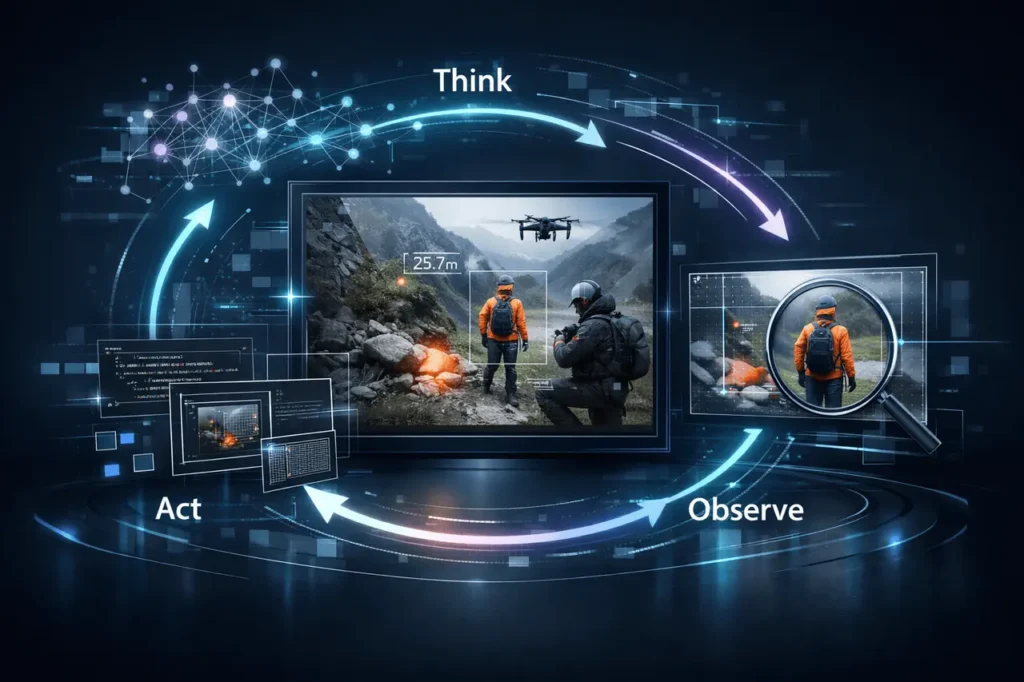
Agentic Vision represents a significant change in how AI systems think and reason about images. Introduced as a key feature in Gemini 3 Flash, Agentic Vision transforms the understanding of images from a single-shot, static interpretation into an active, multi-step reasoning process. By combining visual perception and software execution, this system can analyse, manipulate, and re-inspect visual information before providing a definitive answer, resulting in quantifiable improvements in visual quality across benchmarks.
This is important because many problems in real-world vision cannot be resolved with confidence in a single pass over an image. Agentic Vision addresses this gap by providing well-defined reasoning loops that reflect how humans inspect, test, and verify the images they perceive.
What Is Agentic Vision?
Agentic Vision is an AI capability that views image understanding as an agentic process rather than a static inference. Instead of directly producing an answer after viewing any image or object, it could trigger actions, run code, and monitor the results before deciding.
In its fundamentals, Agentic Vision integrates:
- Visual reasoning
- Programmatic image manipulation
- Iterative context updates
This method allows the model to base its outputs on visual evidence rather than relying solely on internal representations.
Why Agentic Vision Matters?
Traditional vision models usually process an image once and output an output instantly. Although efficient, this approach does not work well for complex tasks such as fine-grained measurement and transformation, or multi-step analysis.
Agentic Vision introduces several important benefits:
- Higher Answer security by using visual grounding
- Better performance of benchmarks, as well as the possibility of a 5-10% increase in quality for the majority of vision benchmarks
- Improved handling of more complex questions with intermediate steps in reasoning
- Reduced hallucination risk by inspecting transformed visual data
These improvements are significant for production-grade AI systems, where accuracy and consistency are crucial.
How Agentic Vision Works? : Think, Act, Observe
Agentic Vision is built around the structured loop of Think-Act-Observe. This loop enables the model to analyze the image in a series instead of all at once.
Think: Planning the Visual Reasoning Strategy
In the Phase of Thinking, the model is:
- analyzes the image query
- Examine the original image context
- Creates a multi-step strategy to address the issue
This stage of planning determines whether the task will require measurement, image transformation, comparisons, or other tasks.
Act: Executing Code on Visual Data
The Act phase of the model is:
- Generates Python code
- executes the code to alter or study the image
Actions could include cropping regions, adjusting contrast, counting objects, measuring distances, or extracting structured information from pixel analysis.
Observe: Re-Inspecting the Transformed Image
In the Watch phase:
- The transformed image is added to the model’s window.
- The model visually inspects the data it has been given.
- The last reasoning was done using the most recent visual evidence.
This closed feedback loop ensures that conclusions are based on the outcomes of the model’s actions.
Agentic Vision vs Traditional Image Understanding
| Aspect | Traditional Vision Models | Agentic Vision |
|---|---|---|
| Reasoning style | Single-pass inference | Multi-step agentic loop |
| Use of code | Not supported | Python code execution |
| Visual grounding | Implicit | Explicit, evidence-based |
| Error correction | Limited | Iterative inspection |
| Benchmark performance | Baseline | 5–10% quality improvement |
This contrast demonstrates the way Agentic Vision shifts image understanding from passive recognition to active problem-solving.
How Visual Reasoning and Code Execution Work Together?
The most notable characteristic of Agentic Vision is its close connection between visual reasoning and code execution. Instead of using images as static inputs, Agentic Vision can process them to execute programs.
The main features of this integration are:
- Dynamic image manipulation is based on the needs of reasoning
- A deterministic operation, which reduces the ambiguity
- Transparent steps, which can easily be observed
This method integrates image comprehension with the trend toward AI tools and systems.
Real-World Applications of Agentic Vision
Agentic Vision enables more robust performance over a broad spectrum of real-world scenarios.
Computer Vision Analysis
- Verification and counting of objects
- Fine-grained visual inspection
- Region-specific analysis
Document and Diagram Understanding
- parsing figures and charts
- Measuring the layout relationship
- Extracting structured data
Scientific and Technical Imaging
- Visual measurement tasks
- Image-based experimentation workflows
- Test of hypothesis through iterative testing
Developer and Automation Workflows
- Programmatic image analysis
- Debugging visual outputs
- Integrating vision into agent-based systems
Benefits of Agentic Vision
Agentic Vision introduces several practical benefits for developers and companies.
- More Consistent visual reasoning outcomes
- Enhances trust in image-based responses
- More aligned with agent-based AI architectures
- Scalable approach for complex visual tasks
These benefits are what make Agentic Vision particularly well-suited for advanced multimodal systems.
Limitations and Practical Considerations
Despite its advantages, Agentic Vision introduces new considerations.
Computational Overhead
- Multi-step loops can boost the amount of latency
- Coding execution needs additional resources
Tooling Constraints
- The effectiveness is contingent on the available tools, for example, Python execution
- Not all tasks in the field of vision benefit equally from the agentic processing
System Design Complexity
- requires careful orchestration of reasoning as well as execution steps
- Multi-step visual reasoning is more complex
Knowing these limitations is crucial when deciding on which areas to use Agentic Vision.
Agentic Vision in the Broader AI Landscape
Agentic Vision reflects a broader shift in AI towards agent-based systems that can plan, act, and watch. Similar principles are being implemented across reasoning, language, and models that use tools.
This trend suggests a future in which vision models aren’t merely perceptual elements but active participants in workflows for solving problems alongside other AI agents.
My Final Thoughts
Agentic Vision marks a significant technological advancement in AI understanding of images by changing perception into a dynamic agent-based process. With its Think-Act-Observe loop, Gemini 3 Flash demonstrates that using visual reasoning alongside code execution can deliver high-quality, quantifiable results and more stable outputs. As AI-based systems advance towards agent-based systems, Agentic Vision is likely to play an essential role in multimodal intelligence in the near future.
FAQs
1. What exactly is Agentic Vision in simple terms?
Agentic Vision refers to an AI method of understanding images that operates through action, planning, and observation, rather than a single static analysis.
2. How can Agentic Vision improve accuracy?
By running the code to manipulate images and then re-examining the results, the model substantiates its findings with visual evidence, reducing the risk of error.
3. What tools does Agentic Vision use?
A prime example of tools supported is Python code execution. It allows the analysis of images programmatically and their transformation.
4. Do you think Agentic Vision slows down image processing?
It could introduce additional latency due to multi-step reasoning. However, this compromise often yields higher-quality outputs.
5. What kinds of tasks can most benefit from Agentic Vision?
Advanced vision tasks like measuring, counting, comparing, and iterative inspection are most beneficial.
6. Is Agentic Vision only useful for developers?
No. While developers have direct control through tools, users gain greater trust and more precise visual explanations.
Also Read –