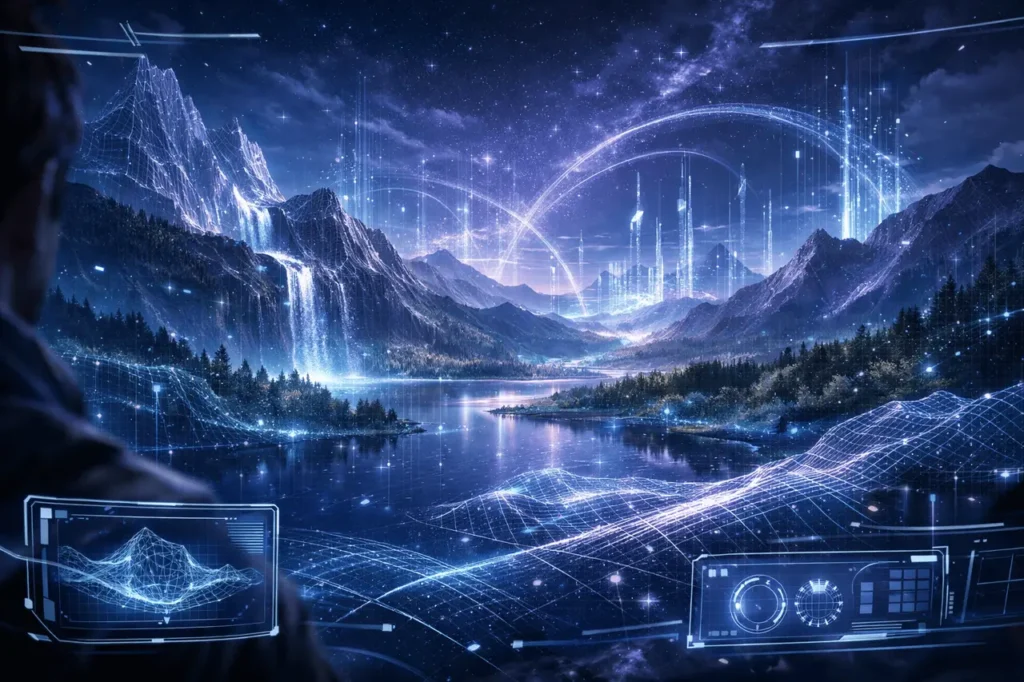
Genie 3 is an upcoming AI world model under development by Google DeepMind for public use, and there are indications it could debut as an experimental Labs release. The model allows users to create interactive, exploratory, and immersive experiences with AI-generated 3D environments that go far beyond static video or image generation.
World models such as Genie 3 are designed to create environments that respond coherently to user actions, making them ideal for interactive AI games, experience prototyping, simulation research, and embodied AI. As it becomes more generative, AI is moving towards interactivity and spatiality. Genie 3 highlights how AI systems are beginning to recognize and create whole worlds instead of isolated outputs.
What is Genie 3?
Genie 3 is a world model, a type of AI system that learns how the environment behaves over time and reacts to changes. Instead of generating a single image or a short video, Genie 3 can create interactive 3D environments that users can explore dynamically.
At a high level, Genie 3 allows users to:
- Create full 3D environments by requiring very little input
- Explore those environments in an interactive way
- See the same object behavior and spatial structure
- Play with AI-generated worlds in real-time
The places Genie 3 as a bridge between a generative AI and an interactive simulation.
Why Genie 3 Matters?
Traditional generative models focus only on static outputs. Genie 3 is significant because it offers the concepts of continuity and interactivity, which are two crucial components for creating digitally realistic worlds.
The main reasons why its release is essential:
- It develops AI from content creation into environment simulation
- It supports experimentation in embodied intelligence
- It removes the hurdle to creating immersive 3D interactive experiences
- It opens new workflows for rapid world prototyping
As AI systems increasingly interface with virtual and human beings, World models such as Genie 3 become foundational infrastructure rather than new tools.
How Genie 3 Works ? (Conceptual Overview)
Although the full technical specifications aren’t publicly available, Genie 3 follows the fundamental principles of modern global models.
Core Components
Environment Generation
The model generates the appearance of a 3D model, including structures, terrain, and objects, that preserve spatial coherence.
Action Conditioned Prediction
User inputs, such as interactions, movements, or motions, are used to predict how the surroundings change over time.
Temporal Consistency
Unlike frame-by-frame generation, Genie 3 maintains continuity so environments feel stable as users explore.
Learned Global Dynamics
The system model’s cause-and-effect relationships allow for possible interactions in the space generated.
Key capabilities of Genie 3
Interactive 3D World Creation
Users can explore AI-generated worlds rather than just look at them.
Prompt-Based Generation
Worlds can be started by following a few simple instructions, reducing the amount of setup work.
Real-Time Exploration
The experience is updated dynamically as the user moves through the area.
Research-Grade World Modeling
Genie 3 is compatible with ongoing research in simulation-based learning and embedded AI.
Genie 3 vs Traditional Generative Models
| Aspect | Traditional Generative Models | Genie 3 World Model |
|---|---|---|
| Output Type | Images or short videos | Interactive 3D environments |
| Interactivity | None | Real-time user exploration |
| Temporal Consistency | Limited | Maintained over time |
| Use Cases | Media creation | Simulation, prototyping, research |
Its shift in focus from passive to active generation is what most clearly differentiates Genie 3.
Real-World Applications
Gaming and Experience Prototyping
Designers can test world-class concepts quickly without a full 3D pipeline.
AI Research and Simulation
World models are essential for training agents to learn from interactions.
Education and Visualization
Interactive environments are a great way to explain complicated physical or spatial concepts.
Creative Experimentation
Technologists and artists can explore new ways to build an AI-driven world.
Use Cases based on Domain
| Domain | How Genie 3 Can Be Used |
|---|---|
| Game Development | Rapid world prototyping and testing |
| Robotics Research | Simulated environments for learning |
| Education | Interactive spatial demonstrations |
| AI Safety | Testing agent behavior in controlled worlds |
Benefits of Genie 3
- Enables interactive AI-generated experiences
- Reduces time and costs for the creation of a world
- Encourages experiments with spatial intelligence
- Allows research into agent-based and embodied AI
- Demonstrates scalable modeling techniques
Limitations and Challenges
Despite its claims, Genie 3 is not free of limitations.
Experimental Status
A Labs-style experiment. The stability and completeness of the feature may differ.
Computational Demands
World models require significant processing power, which limits access.
Control, Predictability, and Control
Generated environments might not behave in the way you expect.
It is not a complete game engine.
Genie 3 is focused on simulation and generation, but not development, which is ready for production.
Practical Uses
Before beginning to experiment with Genie 3, users should be aware of:
- Hardware requirements for real-time interactions
- The exploration-based quality is the basis of laboratory experimentation
- Limitations on customization, export options, and customization
- The appropriate use cases to study and prototype
Understanding these boundaries can help to set reasonable expectations.
My Final Thoughts
Genie 3 represents a meaningful leap forward in AI modeling the world, transforming the generative system away from static content to interactive environments. By allowing users to explore 3D AI-generated environments, it broadens the ways AI can be used to aid creative thinking, simulation, and research.
As the world’s models continue to develop tools like Genie 3, they point toward a future in which AI systems can understand the relationships among action, space, and impact, thus laying the groundwork for more engaging and sophisticated online experiences.
FAQs
1. What exactly is Genie 3 helpful for?
Genie 3.0 is a tool for building and exploring AI-generated 3D worlds interactively, primarily for prototyping, research, and testing.
2. Is Genie 3 available to the general public?
It is anticipated to result from an experiment lab release, which may mean access is limited or accelerated.
3. What makes Genie 3 distinct from other image generators?
Unlike image generators, Genie 3 generates navigational environments that respond to user actions in real time.
4. Could Genie 3 be used for the development of games?
It is an excellent tool for prototyping early in the game, but it isn’t a substitute for a fully-fledged game engine.
5. Does Genie 3 simulate real physics?
It is a model of learning dynamics; however, it may not fully replicate the real-world physical laws.
Also Read –
Google Veo 3.1: Ingredients to Video, 4K Upscaling & AI Video