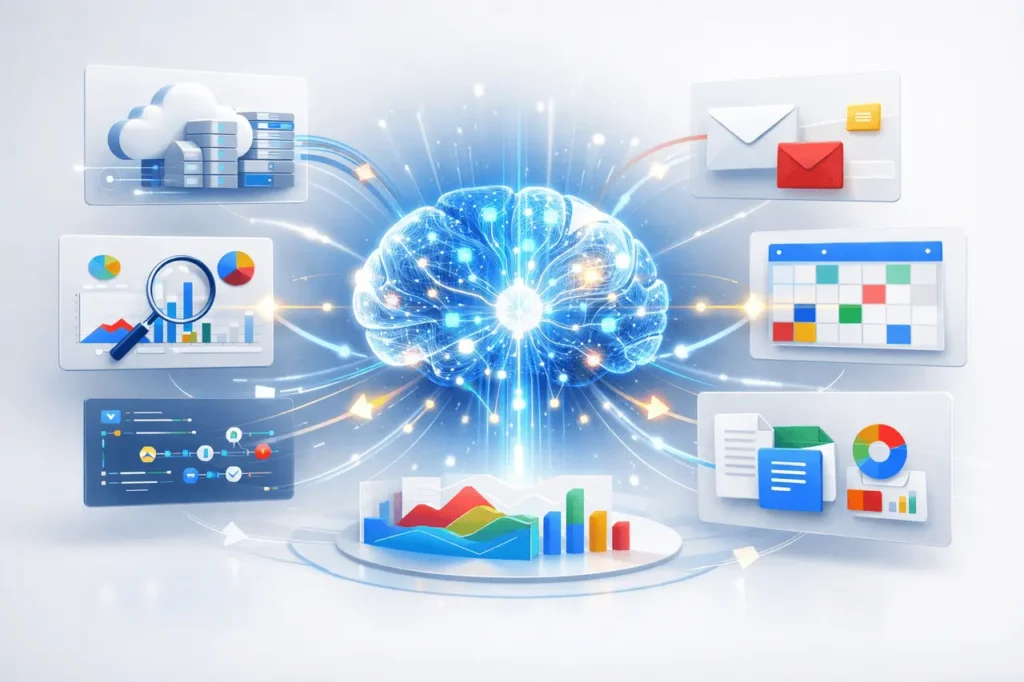
AI agents in Google’s ecosystem are computer programs created to operate autonomously or semi-autonomously and accomplish tasks by combining languages, tools, APIs, and workflows that span Google devices and platforms. Instead of reacting to a single request, the AI agents can decide, use data sources, and continuously work towards the final goal.
Google AI agents are closely linked to advancements in the Gemini model, Google Cloud services, Workspace apps, and developer tools. They are a transition from one-turn AI assistance towards goal-oriented, tool-using AI systems that work across different applications.
Reason AI Agents Are Important within the Google Ecosystem?
Google AI agents are important because they allow automation and decision-making on a much higher level than chatbots or scripts. Instead of coding rules in a hard-coded way, agents can reason, select tools, and adjust their behaviour based on contextual factors.
For companies that already employ Google Cloud, Workspace, or Android, this method enables AI to be directly integrated into existing workflows. The result is less work for humans, quicker process completion, and greater scalability of AI across products and teams.
Define AI Agents in the Google Context
In the Google ecosystem, an AI agent typically comprises:
- A basic model, for example, a Gemini model, that helps in reasoning and understanding of language
- Access to APIs, tools or extensions (for instance, searching databases, Workspace actions)
- An orchestration or planning layer that determines which actions to follow
- State or memory used to monitor progress over multiple steps
In contrast to simple assistants, these software agents can execute sequences of actions, such as finding information, modifying it, and executing subsequent actions, without user input.
How do AI Agents Work Across Google Platforms?
Core Components
AI agents within Google’s ecosystem typically rely on these components working in tandem:
- Model Layer: The Gemini model offers analysis, understanding of multimodality, and instruction-following.
- Access to Tools: Agents can access APIs, run codes, query data or use Google Services.
- Orchestration: The logic that decides the order of tasks, as well as retries and stopping circumstances.
- Context and the Memory: The information from previous steps or sessions is used to guide the future steps.
Integration with Google Cloud
In Google Cloud, AI agents are typically built using managed services that provide model hosting, tooling, and secure access to data. Developers can join agents
- Data warehouses and databases
- Intern APIs as well as microservices
- Logging and monitoring systems
This tight integration makes agents ideal for enterprise applications that require scalability and governance.
Integration with Google Workspace
In Workspace, agent-like features can be utilised to assist with tasks such as drafting documents, composing information, organising data, or performing actions in Docs, Gmail, Sheets, and Calendar. These agents work with user permissions and existing collaboration tools.
Important Use Cases that AI Agents can use in Google’s Ecosystem
Enterprise Operations
AI agents can automate repetitive tasks in the workplace, for example:
- Reports can be generated using various data sources
- Monitoring systems and summarising alerts
- Assisting with internal information retrieval
Software Development
Developers use agents to:
- Analyze codebases
- Generate or refactor code
- Tests to run and interpret the results
By integrating with Google Cloud repositories and CI pipelines, agents can support complete development workflows.
Help Desk and Support for Customers
Agents are able handle customer interactions in multiple steps by:
- Understanding user intent
- Fetching relevant account or product information
- Resolutions that are proposed or executed
It surpasses scripted chatbots by enabling interactive decision-making.
Analysing and Insights into Data
AI agents can use data to query, generate summaries, produce summary reports, and provide natural-language explanations of trends. When connected to analysis tools, they help non-technical users explore data without writing queries.
Table Common use cases and agent capabilities
| Use Case Area | Agent Capabilities | Google Platform Involved |
|---|---|---|
| IT operations | Monitor, summarize, and suggest actions | Google Cloud |
| Document workflows | Draft, summarize, and cross-reference content | Google Workspace |
| Software engineering | Code analysis, testing, and refactoring | Google Cloud |
| Customer support | Intent handling and multi-step resolution | Cloud and Workspace |
Advantages of AI Agents within Google’s Ecosystem
Automatization Boosted
Agents eliminate the need for manual intervention by managing entire workflows rather than specific tasks.
Context-Aware Intelligence
Since agents can access data and preserve status, their outputs become more reliable and consistent throughout the steps.
Ecosystem Integration
The native integration of Google services lets agents be in the same place users are already working, minimising friction.
Scalability
When hosted in Google Cloud, agents can scale to handle large numbers of tasks while ensuring performance.
Google AI agents: Limitations and Challenges
Control, Predictability and Control
AI agents could exhibit unanticipated actions if not controlled. Monitoring and guardrails are crucial.
Data Governance
When agents have access to enterprise information, strict permissions and controls are required to ensure compliance.
Cost Management
Agents running that make multiple model or tool calls can result in higher operating costs.
Test and Evaluation
Measuring agent performance is more difficult than evaluating systems that respond to a single request, particularly for multi-step tasks.
Table: Advantages and Limitations of AI Agents
| Aspect | Advantages | Limitations |
|---|---|---|
| Task handling | End-to-end automation | Harder to predict outcomes |
| Intelligence | Context-aware reasoning | Requires careful prompt and tool design |
| Integration | Native Google ecosystem access | Tied to platform-specific services |
| Scalability | Cloud-native scaling | Cost can grow with complexity |
Practical Business Considerations
Before implementing AI agents within the Google ecosystem, businesses must consider:
- Determining clear boundaries and goals in agents’ behaviours
- Beginning with very narrow and high-impact usage cases
- Monitoring, the logging of events, and human override options
- Ensure that data access is in line with compliance and security policies
A gradual approach can reduce risk while also demonstrating the value.
My Final Thoughts
AI agents in Google’s ecosystem signal a shift towards more autonomous, goal-oriented AI systems that run on cloud platforms, productivity tools, and software. By combining powerful models, tool access, and orchestration, the agents enable greater automation and more efficient workflows.
As companies continue to embrace AI in their work, understanding how these agents operate, where they are valuable, and how to address their limitations is crucial. With careful planning and control, AI agents are likely to play a greater role in how work gets carried out in Google’s ecosystem.
FAQs
1. What’s the main difference between the two? AI agent and chatbots?
A chatbot usually responds to a single request, whereas an AI agent can create plans, use tools, and complete multiple-step tasks autonomously.
2. Are AI agents from Google’s ecosystem suitable for companies?
Yes, if they are built on Google Cloud services, they can meet enterprise security, scalability, and governance requirements.
3. Do AI agents require custom development?
Some agent capabilities are built into Google products, but advanced uses typically require additional setup or even development.
4. Can AI agents gain access to sensitive business information?
They can, but only with specific permissions. Auditing and access control are essential.
5. What is the process by which AI agents are rated on accuracy?
Evaluation typically incorporates automated measures, task completion rates and human review to determine the reliability
Also Read –