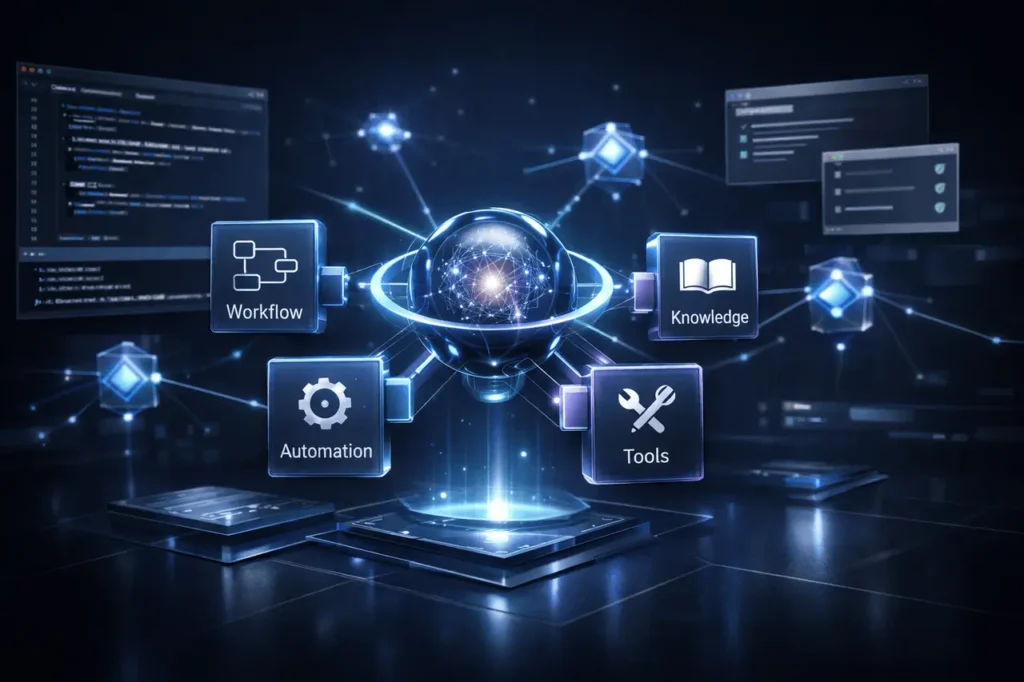
Google’s Antigravity platform is a revolutionary new direction for AI-driven development and agent orchestration. It was released to the public in November 2025, alongside Gemini 3, Google’s most sophisticated AI system. Antigravity moves beyond traditional software assistants and creates an agent-first development environment in which autonomous AI agents can plan, execute, verify, and even test tasks across terminals, code, and browser interfaces. The latest system enhancement, Agent Skills, unlocks an effective way to expand what your agents can do by organizing their expertise into modular, searchable units.
The article explains Google Antigravity Agent Skills, and the basics of what Agent Skills are, how they work with Google Antigravity, and why this open standard for extension of capabilities is crucial for teams, developers, and companies looking to increase the efficiency of their agentic workflows.
What Is Google Antigravity?
Before you dive deep into Agent Skills, it’s essential to know the basis they are built on. Google Antigravity is an AI-powered integrated development environment (IDE) built on the premise that intelligent agents, not just code suggestions, are essential to software development. Instead of automating the completion of each line of code, Antigravity employs autonomous agents that can comprehend complex tasks, break them down, and execute them across a variety of applications and platforms, ranging from writing and testing code to evaluating results in browsers.
The most essential features of Antigravity are:
- Agent-First Interface Agents are the primary agents that work in a self-contained manner on projects, while the developer serves as the architect or supervisor.
- Multi-Surface Control: Agents can use a unified IDE, terminal, and browser to design code, test, and validate outputs.
- Artifacts to Help with Transparency: Agents generate evidence-based deliverables that can be verified, including planned implementation plans, implementation steps, recordings, and screenshots that allow developers to monitor and review the progress.
- View of the Manager for Orchestration: A dashboard for mission control lets you create and manage multiple agents operating in parallel, enabling complex, synchronous workflows.
Antigravity can be downloaded as a public preview for macOS, Windows, and Linux, with support for Google accounts and significant usage limits for supported models, such as the Gemini 3 Pro.
Introducing Agent Skills in Google Antigravity
At the beginning of 2026, Google introduced Agent Skills to its Antigravity platform. It is a novel method for expanding agents’ capabilities by codifying structured information and processes into reusable components. According to the company’s announcements, “Skills are an open standard to extend what your agent can do”. They can be used to encapsulate workflows specific to a particular project or general tools that agents can load and use as needed.
This change aligns with broader trends in agent design, which emphasize portability, composability, and reusable knowledge as vital to scaling complex real-world workloads. The introduction of Agent Skills enables developers to define specific behaviours and conventions that agents can follow across tasks, without having to manually repeat long instructions.
What Makes Agent Skills Valuable?
Agent Skills is based upon an open standard, which is a reference to:
- They can be reused, shared, and modified across teams and projects.
- They ensure uniformity in how agents carry out tasks while minimizing the risk of errors and inconsistent behavior.
- They eliminate the need to incorporate long prompts or task-specific guidelines directly into each interaction, while preserving the capacity of context and increasing effectiveness.
In the real world, the Agent Skill functions as a tiny package of domain-specific knowledge. It can define how to manage code reviews, implement architectural guidelines, adopt testing patterns, or establish specific business regulations. When a Skill is determined, agents can recognize when a particular Skill is being used and load its instructions as they execute tasks.
How Agent Skills Work?
While the details of implementation are changing, the basic model for Agent Skills in Google Antigravity is a modular design that is easily discovered :
- Skill Definition: Each skill is recorded in a folder that has at the very least an SKILL.md file. The Markdown document includes:
- Metadata – Like name and description (often via YAML frontmatter)
- Instructions – Clear, organized guidance to help the agent perform tasks that are in line with the skill’s intention
- Skill Discovery: Once an agent session begins, Antigravity scans configured skill directories (global settings or workspace-specific folders) and creates a concise list of available skills based on metadata.
- Relevance Evaluation: If the agent finds that the current job matches the description of a Skill and that the description is accurate, it follows the instructions to guide its actions.
- Execution: The agent is guided by the instructions for its skill, along with its own thinking and planning, making decisions based on its general intelligence and the specific rules for the task encoded in the ability.
This method reduces the amount of context space needed. It helps avoid loading the full contents of a skill too early, while still providing agents with deep procedural knowledge only when necessary.
Use Cases: Practical Benefits of Agent Skills
Agent Skills open up a variety of real-world possibilities for developers and teams:
1. Project-Specific Workflows
Create procedures and conventions unique to the architecture or repository, such as code standards, feature-schematizing patterns, CI/CD requirements, and deployment workflows, and ensure agents adhere to them promptly.
2. Global Utilities
Develop reusable abilities to perform routine tasks, such as guidelines for formatting, as well as testing strategies and templates for documentation, and then apply them to any project without duplicate instructions.
3. Team Alignment
Embed the team’s agreement regarding coding styles, security standards, styles, and best practices in error-handling into the agent’s decision-making process and ensure consistency when multiple parties and automated procedures are used.
4. Knowledge Portability
Because skills are an open specification, they can be shared across platforms and used with other platforms by agents that adhere to the exact specification, improving cross-tool interoperability.
How to Start by Using Agent Skills?
At a higher level, adopting Agent Skills in Google Antigravity is:
- The process of identifying processes, as well as processes you’d like agents to manage consistently.
- Create the skills directory using the SKILL. An MD file that includes information and guidelines.
- Inscribing the skill within an international or project-specific directory that is recognized as such by Antigravity.
- The process of starting an antigravity session involves allowing the agents to identify and use the relevant skills they have learned during the tasks.
It encourages iterative design of skills. Start with a few targeted skills, then expand them as you define the tasks you want agents to complete.
Future Outlook
The incorporation of Agent Skills into Google Antigravity represents a broader change in AI development. Systems are moving away from single-off commands and static interactions toward the adaptable, reusable, and scalable behavior of agents. By encoding skills as organized knowledge units, designers can develop more efficient, reliable, and repeatable workflows for agents that are compatible with corporate norms.
In the future, as AI technology platforms grow and evolve, the open standard that underlies Agent Skills may serve as an everyday basis for interoperable agent capabilities across different ecosystems, helping eliminate unnecessary prompt engineering and allowing agents to behave more like trained, collaborative agents rather than analytic assistants.
My Final Thoughts
Agent Skills fundamentally change how developers use AI agents in Google Antigravity. With the introduction of an open, modular standard for encoding processes and knowledge, Google is addressing one of the most significant challenges facing agentic systems: scaling up reliable behaviour without relying on brittle instructions or manual supervision.
Skills enable agents to work with greater clarity, follow the rules of their particular project, and reuse practices proven to work across codebases and teams. As the tools for agent-first development become more advanced, the model of reusable abilities that are easily discovered is likely to be a key component of serious AI-assisted development. For those who invest in autonomous agents, Agent Skills is a viable way to create more predictable, maintenance-friendly, efficient, and production-ready workflows.
Frequently Asked Questions
1. What are Agent Skills in Google Antigravity?
Agent Skills are modular, reusable pieces of structured information and instruction that expand an AI agent’s capabilities by placing task-specific rules in searchable skill files.
2. What is the way Antigravity makes use of these abilities?
Antigravity scans skill directories configured before the session starts, determines the skill’s relevance based on the task context, and provides complete instructions for a specific skill that matches the current requirement, as well as guiding the agent’s actions.
3. Why are Agent Skills important for developers?
They provide consistency, reduce prompt repetition, codify best practices, and make the agent workflow more efficient and reliable across all projects.
4. How can I store my skills?
Skills can be organized in workspace-specific folders for project guidelines, or in global directories to make them easier to reuse across projects.
5. What format does Agent Skills use?
Typically, every skill has the SKILL.an MD file that contains metadata (like description and name) as well as detailed instructions for agents must follow.
6. Do you think Agent Skills are compatible with other platforms?
Since skills are an open specification, they can be integrated into other AI agent platforms that use the exact specification, although the details depend on how they’re implemented.
Also Read –