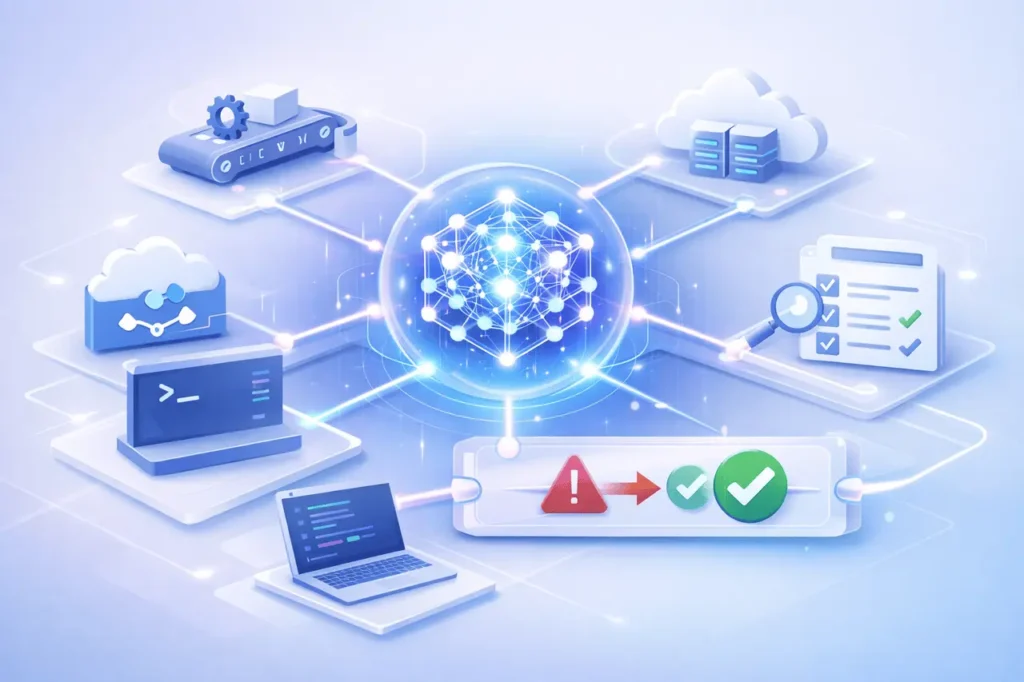
Google MCP integrations were released along with two significant updates for developers, including an updated CI Fixer feature in testing for Jules SWE Agent and the introduction of Gemini 3 Flash as Google’s new base model for all users and plans. Together, these changes signal a direction toward faster AI-driven development, greater tool interoperability, and more automated Software maintenance workflows.
This article explains what these releases mean, why they are essential, how they work in practice, and what teams need to consider when adopting them.
What Are Google MCP Integrations?
Google MCP integrations link Google’s AI agents to tools and services using the Model Context Protocol (MCP). MCP was designed to allow AI models access to APIs, external systems, or development environments in a standardized manner.
Why MCP Matters for AI Development?
Before the introduction of MCP-style integrations, AI agents typically relied on handcrafted connectors, which were often brittle and custom. MCP provides a more uniform interface for accessing tools that allows:
- More secure and safer tool use
- Easy integration with the workflows of existing developers
- Lower overhead associated with creating custom connectors
Supporting MCP Google enables its AI agents to operate with greater context and access to real-world systems while still preserving governance boundaries.
How Google MCP Integrations Work?
At a larger scale, Google MCP integrations allow AI agents to:
- Explore tools that are available via standard descriptors
- Request context-based requests from other systems
- Perform tasks that are scoped, like checking files and reading them, or re-updating artifacts
This method is particularly suitable for software engineers who require access to CI pipelines, repositories, and configuration files.
Practical Capabilities Enabled by MCP
- Context-aware code analysis
- Automated checks linked to systems for CI
- Write access is controlled for corrections and updates
These capabilities provide the basis for features such as CI Fixer.
Jules SWE Agent and the New CI Fixer (Beta)
Jules SWE Agent is Google’s software engineering agent that was designed to aid in coding, testing, maintenance, and other tasks. The recently revealed CCI Fixer tool is in beta.
What does CI Fixer do?
CI Fixer focuses on continuous integration problems. If the CI job fails, the agent can review the failure indicators and take corrective action.
The main goals are:
- The source of CI failures
- The idea of proposing or implementing specific fixes
- Reducing manual debugging time
Since CI Fixer is in beta, the capabilities and workflows could change.
CI Fixer in the Development Workflow
CI Fixer was created to be integrated directly with existing CI pipelines, rather than replace them.
Typical CI Fixer Flow
- A CI pipeline fails during testing or validation
- Jules SWE Agent examines logs and configures context
- The CI Fixer recommends or makes changes
- The process is then run to verify the results.
This model focuses on controlled, iterative automation rather than fully self-contained changes.
Gemini 3 Flash: Google’s New Base Model
In addition to MCP integrations and CI Fixer, Google launched Gemini 3 Flash for all users across all plans. It’s the standard model for all users.
What Makes Gemini 3 Flash Different?
Gemini 3 Flash is described as:
- More efficient than models
- More capable across general tasks
- Optimized to be responsive for daily use
The idea behind the model is to enhance the speed and reliability of AI-assisted workflows, especially when empowering agents such as Jules.
How Gemini 3 Flash Impacts Jules and MCP Integrations?
Gemini 3 Flash serves as the base framework for many interactions that directly affect agent performance.
Relevant implications include:
- Faster tool calls via MCP
- A more responsive analysis of CI
- More efficient multi-step reasoning for developing tasks
This explanation explains why agent behavior might feel faster following the upgrade.
Feature Overview Table
| Feature | Purpose | Status |
|---|---|---|
| Google MCP Integrations | Standardized tool and system access | Released |
| CI Fixer (Jules SWE Agent) | Automated CI failure resolution | Beta |
| Gemini 3 Flash | Faster, more capable base AI model | Released |
Benefits of These Updates for Developers
Key Advantages
- Reducing time spent debugging CI issues
- More reliable AI tool integrations
- Faster feedback loops during development
Team-Level Impact
- Improved developer productivity
- More effective use of AI for maintenance tasks
- Lower operational friction in CI/CD pipelines
Limitations and Practical Considerations
While these improvements are significant, the teams must be aware of the current restrictions.
Known Considerations
- The CI Fixer is still in beta and will not be able to handle all types of failures
- MCP integrations require a proper access configuration
- Human review is still vital for changes to production
The gradual adoption of these tools and the tracking of their outputs are recommended.
Use Cases by Development Scenario
| Scenario | How MCP and CI Fixer Help |
|---|---|
| CI/CD Pipelines | Faster identification and remediation of failures |
| Large Codebases | Context-aware analysis across repositories |
| DevOps Teams | Reduced alert fatigue and manual fixes |
My Final Thoughts
Google MCP integrations, the CI Fixer beta version for Jules SWE Agent, and the release of Gemini 3 Flash together represent a significant advancement in AI-assisted software development. MCP is the structural backbone for secure access to tools. CI Fixer targets one of the time-consuming aspects of modern software development. At the same time, Gemini 3 Flash delivers the performance and speed improvements required to enable these systems at scale.
While these techniques develop, they will likely play a greater role in how teams design, test, and maintain their software in AI-augmented environments.
FAQs
1. What exactly are Google MCP integrations for?
Google MCP Integrations allow AI agents to secure access to tools such as services, systems, and tools through a standardized protocol, enhancing the efficiency of automation and understanding context.
2. Are CI Fixers fully autonomous?
No. CI Fixer helps diagnose and repair CI issues. However, it’s designed to function in conjunction with humans, particularly in its early stages.
3. Who can use Gemini 3 Flash?
Gemini 3 Flash is available to everyone across all plans and acts as Google’s brand-new standard base model.
4. Can CI Fixer modify code automatically?
CI Fixer can suggest or implement changes based on the configuration. Teams must review outputs before merging.
5. Are MCP integrations restricted to software development?
In addition to being helpful to software engineers, the MCP interfaces can also assist with other tool-based workflows when controlled access to systems is required.
Also Read –