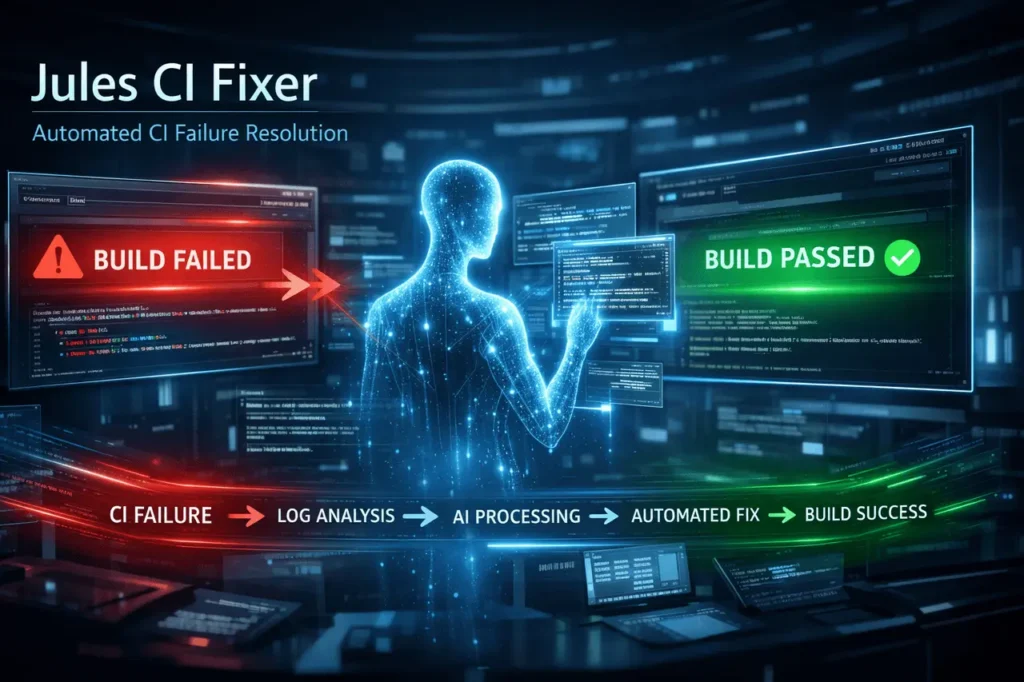
On February 19, 2026, Google released a major update to Jules, the AI-powered development agent: Jules CI Fixer. This new feature allows Jules to detect and fix CI errors, changing the way teams working on development manage pipeline errors.
Jules CI Fixer is designed to simplify the continuous integration process by finding, analysing, and resolving CI issues without manual intervention. In addition to the update, Google added an authorship option that allows Jules to make modifications under the developer’s name, which is in line with standard DevOps workflows.
This article explains what the Jules Fixer is, what the CI Fixer is, how it works, its significance, and how it is integrated into modern software engineering practices.
What Is Jules CI Fixer?
Jules CI Fixer is an application that automatically resolves Continuous Integration (CI) issues. If a build fails within the CI pipeline, Jules can:
- Receive failure notifications
- Examine logs and error output
- Identify root causes
- Apply fixes to the code
- Contribute updates to the repository
The norm is that CI issues require manual investigation by engineers. Jules CI Fixer shifts that burden by automating the initial reaction to pipeline problems.
This improvement positions Jules as an active participant in CI/CD pipelines rather than a passive code aid.
Why Jules CI Fixer Matters for DevOps Teams?
Modern environments for development rely heavily upon CI platforms to
- Automated tests
- Validate pull requests
- Enforce code quality
- Ensure deployment readiness
But CI failures are frequent and often repetitive. The most common causes are:
- Test regressions
- Dependency conflicts
- Configuration errors
- Linting violations
- Environment mismatches
Jules CI Fixer reduces time-to-resolution for these issues. Instead of waiting for a developer to investigate the issue, the system starts working immediately.
Key Benefits
- Faster build recovery
- Context switching for engineering has been reduced
- Lower operational overhead
- Improved deployment velocity
- Continuous codebase stability
For companies that have high-frequency deployments. This capability will greatly improve pipeline reliability.
How does Jules CI Fixer work?
Although the exact internal architecture isn’t publicly divulged, the operation workflow can be described in the following manner:
1. CI Failure Detection
If a CI job is unsuccessful, Jules is automatically notified.
2. Log Analysis
Jules analyses errors, build logs and test outputs to identify the root of the issue. .
3. Code Reasoning
By using its understanding of code abilities, Jules evaluates potential fixes in line with the project’s standards.
4. Automated Contribution
Jules creates the fix and then contributes it straight to the repository.
A new authorship option lets Jules contribute changes while the developer is in charge, in line with repository policies on contributions.
Feature Comparison: Before vs After Jules CI Fixer
| Aspect | Traditional CI Handling | With Jules CI Fixer |
|---|---|---|
| Failure Detection | Manual review of alerts | Automatic intake |
| Root Cause Analysis | Engineer investigation | AI-driven analysis |
| Fix Implementation | Developer writes patch | Jules proposes/applies fix |
| Time to Resolution | Variable (hours/days) | Potentially immediate |
| Developer Involvement | Required from start | Often only for review |
This change reduces debugging time and speeds recovery.
Authorship Setting: Contributing as You
In addition to CI Fixer, Google introduced an authorship setting feature. This lets Jules:
- Attribute commits the developer
- Operate in compliance with the rules for contribution to a repository
- integrates seamlessly with workflows already in place
This is crucial to:
- Compliance requirements
- Contribution tracking
- Ownership models for repositories
- Code review pipelines
It ensures automated fixes do not disrupt established collaboration norms.
Jules CI Fixer and Continuous Integration Automation
Primary Keyword Subheading:
How Jules CI Fixer Enhances Continuous Integration Automation?
Continuous integration automation aims to detect integration issues early and maintain good code health. However, detection alone does not solve problems.
Jules CI Fixer adds an automated remediation layer to CI systems. Instead of halting with “build failed,” the pipeline is now:
- Detect
- Diagnose
- Repair
- Validate
It is the final step in the CI/CD workflow.
Impact on DevOps Workflows
| DevOps Area | Impact of Jules CI Fixer |
|---|---|
| Build Stability | Faster restoration of green builds |
| Developer Productivity | Reduced interruption from minor failures |
| Code Quality | Immediate correction of failing patterns |
| Release Cycles | Shorter recovery windows |
| Automation Maturity | Higher pipeline autonomy |
For businesses seeking advanced DevOps maturity, automated CI failure resolution can be an important step in the right direction.
Real-World Applications
Jules Fixer for CI is particularly important in:
Large Engineering Teams
Increasing commit frequency increases the likelihood of CI failures. Automated fixes can reduce the coordination cost.
Open Source Projects
Maintainers are often responsible for recurring test failures. AI assistance can ease the pressure on backlogs.
Microservices Architectures
Multiple pipelines and repositories can increase the surface area for detecting integration errors.
Rapid Deployment Environments
Businesses that use continuous deployment can benefit from an instantaneous failure remedy.
Benefits of Jules CI Fixer
- Proactive CI management
- Reduced downtime in pipelines
- Improved developer focus
- Lower cognitive load
- Faster feedback loops
By incorporating Intelligence directly into CI procedures, groups can move from debugging reactively to active optimization.
Limitations and Practical Considerations
When Jules CI Fixer introduces powerful automation, businesses should think about:
Review Processes
Automated fixes need to be reviewed for accuracy and conformity with architectural standards.
Complex Failures
Architectural or context-specific problems may need manual assistance.
Security and Governance
Automatic commit capability should align with repository permissions and compliance requirements.
CI System Compatibility
Teams must ensure they can integrate into their CI/CD tooling.
As with every development tool driven by artificial intelligence, monitoring and configuration remain vital.
Strategic Implications for AI-Assisted Development
Jules CI Fixer signals an overall trend in software development: AI agents evolving from advisory tools to active contributors.
Instead of just offering code to IDEs, AI systems do:
- Monitoring pipelines
- acting in response to operational signs
- Writing and fixing
- Participating in DevOps ecosystems
This shifts towards self-contained engineering workflows. AI enhances both coding and operational resilience.
My Final Thoughts
Jules CI Fixer represents a significant advancement in automated code maintenance and Continuous Integration Automation. By automating the processing and resolution of CI errors, Jules reduces friction in DevOps workflows and speeds up rebuild recovery times.
The inclusion of an authorship setting enables seamless integration with existing development environments, ensuring developer accountability while enabling automation.
The AI agents continue to move beyond assistance based on suggestions to operational autonomy. Jules CI Fixer demonstrates the way software engineering is moving towards self-healing, intelligent pipelines.
In the modern-day development environment, where speed, reliability, and automation are crucial, Jules CI Fixer is positioned as an innovative technological advancement in AI-driven DevOps architecture.
Frequently Asked Questions
1. What is Jules CI Fixer?
Jules CI Fixer function that enables Jules to take in and address CI failures by looking at logs, and then suggesting or applying solutions.
2. When was the introduction of Jules CI Fixer?
Jules ‘ CI Fixer was released on February 19, 2026.
3. Does Jules CI Fixer replace developers?
No. It automates handling CI errors while operating within the review and governance guidelines established by teams.
4. What is the process for setting authorship? function?
Authorship settings permitallow Jules to make code modifications under a developer’s identity while aligning with the repository’s contribution policy.
5. Does Jules CI Fixer handle all CI failures?
It was designed to resolve a wide range of CI issues, but more complex or architectural issues could require manual intervention.
6. Is Jules Fixer part of Google’s development ecosystem?
Yes. Google develops Jules and continues to enhance its AI-assisted software engineering capabilities.
Also Read –
Google MCP Integrations: CI Fixer | Jules and Gemini 3 Flash