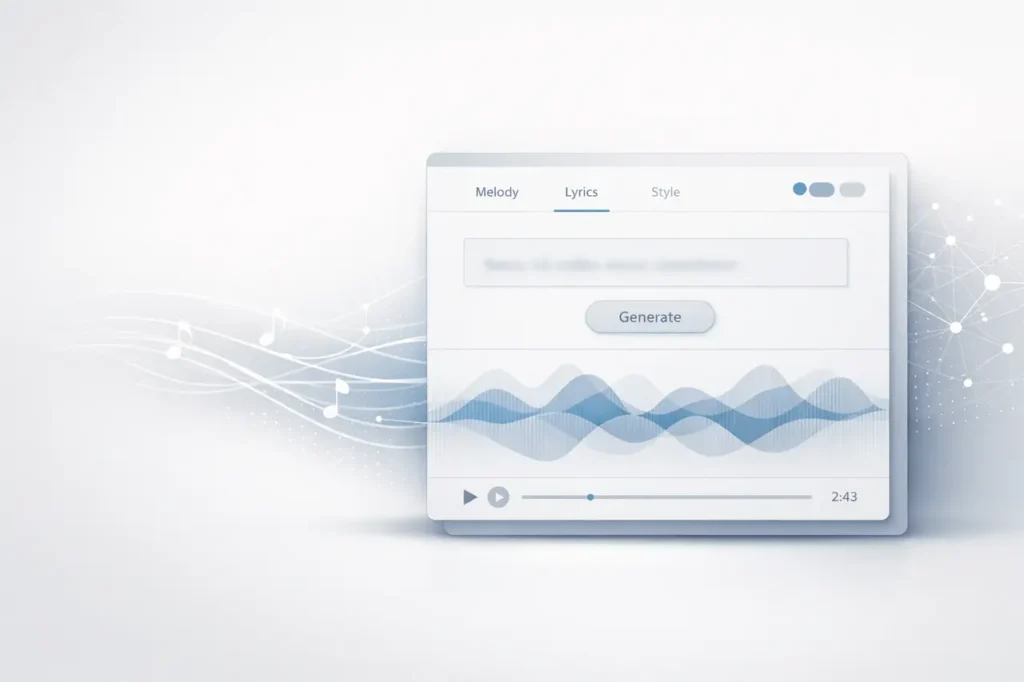
ProducerAI is now part of Google Labs, marking a significant advancement in AI music production. This move aligns ProducerAI’s innovative instruments with Google Labs’ broader mission to boost the development of artificial intelligence.
With the help of research conducted by Google Labs, ProducerAI integrates with Lyria 3, an advanced AI music engine designed to aid artists in creating lyrics, creating melodies and experimenting with different genres. The aim is simple: to make top-quality music production accessible to artists at every stage.
This article explains the basics of ProducerAI, why its integration with Google Labs matters, how Lyria 3 improves AI-generated music, and what this will mean for artists and the music industry as a whole.
What Is ProducerAI?
ProducerAI is an artificial intelligence-powered music production platform that was designed as a partner rather than a substitute for human musicians. It aids in the creation of music through multiple stages:
- Lyric ideation
- Melody development
- Genre experimentation
- Track structuring
Unlike traditional generative tools, ProducerAI is designed to operate by interacting with users, enabling them to develop and refine their ideas rather than producing fully autonomous outputs without user input.
Its integration with Google Labs strengthens its technical base and aligns it with modern AI Research infrastructure.
ProducerAI and Google Labs: Why This Matters?
Google Labs serves as a central hub for AI product experiments and early-stage innovation. In the integration of ProducerAI in Google Labs, the platform has access to:
- Advanced AI model research
- Scalable infrastructure
- Responsible AI development frameworks
- Broader creative AI initiatives
The integration is a strategic move towards AI-powered creative tools, specifically in music generation.
Harmonisation with Lyria 3
ProducerAI has a common goal: introducing Lyria3, Google’s AI music model that empowers users to create and manipulate music from their minds.
Both platforms emphasise:
- Making music more accessible
- Artists of all levels of skill
- Enabling genre flexibility
- Encouraging experimentation
This alignment ensures that ProducerAI is built on a solid AI music foundation, not a stand-alone tool for experimentation.
What Is Lyria 3?
Lyria 3 is an advanced AI model developed by Google within its AI research ecosystem to aid in music creation. It lets users create structured, dynamic music using prompts and guiding inputs.
Core Capabilities of Lyria 3
Lyria 3 is not meant to replace musicians, but rather to serve as a support system that helps explore creativity.
How ProducerAI Works Within Google Labs?
ProducerAI functions as an interactive AI collaborator. Users can:
- Input lyrical themes or emotional tones
- Develop melodic ideas
- Play around with genre transformations
- Remix compositions
The system responds dynamically, allowing it to be refined in real time.
Traditional Music Creation vs AI-Assisted Workflow
This alteration helps reduce friction in the creative process while keeping creative decision-making under user control.
Why AI Music Creation Is Expanding?
AI music instruments are gaining popularity because of several factors that are converging:
- Creativity of the economic platforms
- Access to AI that is generative AI
- Demand for fast content creation
- Lower barriers to entry for technical reasons
ProducerAI’s decision to join Google Labs signals confidence in AI-assisted music as an artistic infrastructure layer rather than a short-term trend.
Real-World Applications of ProducerAI
1. Independent Artists
Individually-based musicians may make use of ProducerAI to:
- Overcome creative blocks
- Explore new genres
- Prototype song structures
It reduces production time and lowers cost barriers.
2. Content Creators
Podcasters, video creators, and marketers increasingly need customised audio tracks. AI-generated music makes it easy to create customised soundscapes.
3. Music Education
Artists who are beginning to learn compositional patterns by interfacing with AI-generated suggestions and gaining exposure to the principles of musical theory that are embedded in the outputs.
4. Rapid Prototyping for Studios
Professional studios can use AI music generation to create concept drafts before full-scale production.
Benefits of ProducerAI Under Google Labs
1. Research-Backed Development
Integration into Google Labs ensures the tool is backed by continuing AI research, not traditional algorithms.
2. Scalable Infrastructure
Google’s cloud-based AI system and its algorithms ensure the highest level of performance and reliability.
3. Responsible AI Frameworks
Google Labs emphasises safety, transparency, and responsible AI use, which are crucial to the development of innovative generative tools.
4. Cross-Product Innovation Potential
ProducerAI could eventually be integrated with other AI-driven tools for creative creation, enabling a broader range of workflows spanning media formats.
Limitations and Practical Considerations
While the AI-powered music generation is improving, users must be thinking about:
- AI outputs need human intervention to achieve artistic depth
- Originality in creative design is still dependent on the direction of the user
- Ethical considerations regarding training data and attributing
ProducerAI is advertised as a collaborative platform, meaning it is most effective when guided by human imagination.
How ProducerAI Supports Artists at Every Level?
One of the main tasks shared by ProducerAI and Lyria 3 is accessibility.
The platform is designed to offer:
- Beginning musicians experimenting with music creation
- Semi-professional creators refining skills
- Experiential artists looking for new ideas
This tier-agnostic method increases participation in music production without decreasing the quality standards.
The Future of AI Music at Google Labs
The incorporation of producerAI with Google Labs indicates a broader focus on artificial intelligence-powered creative.
As AI models like Lyria 3 evolve, we can expect:
- Better musical coherence
- More stylistic control
- More subtle emotional expression
- Improved collaboration interfaces
AI music creation is becoming an enhancement layer to human creativity, not an automation replacement.
My Final Thoughts
ProducerAI Joins Google Labs at a pivotal moment in AI music production. In partnership with Lyria 3 and Google Labs’ AI research ecosystem, the platform bolsters its position as a partner for musicians at all skill levels.
The integration demonstrates an overall shift towards AI-assisted creative workflows. tools boost imagination, increase exploration, and broaden accessibility without compromising human creativity.
In the same way that AI musical models continue to develop, ProducerAI’s entry into Google Labs may represent a first step towards a longer-term change in the way music is composed, imagined, and recorded in the age of digital.
FAQs
1. What is ProducerAI?
ProducerAI uses AI as a music-making tool to help users compose lyrics, create melodies, and experiment with genres interactively.
2. What exactly does ProducerAI being a part of Google Labs mean?
This means that ProducerAI is now backed by Google Labs’ AI research infrastructure, enhancing its capabilities and scalability.
3. What is the relationship between Lyria 3 and ProducerAI?
Lyria3 can be described as an AI music model aligned with ProducerAI’s goal of enabling the creation of high-quality, accessible music with AI assistance.
4. Are beginners able to utilise ProducerAI efficiently?
Yes. The platform was specifically designed to help musicians at all levels, including those just beginning their journey and those without formal musical training.
5. Does ProducerAI replace musicians?
No. It is an instrument for collaboration that can enhance human creativity rather than substitute for it.
6. Can AI-generated music be customised?
Yes. ProducerAI supports iterative refinement, so users can tweak and shape outputs to suit their vision of art.
Also Read –